
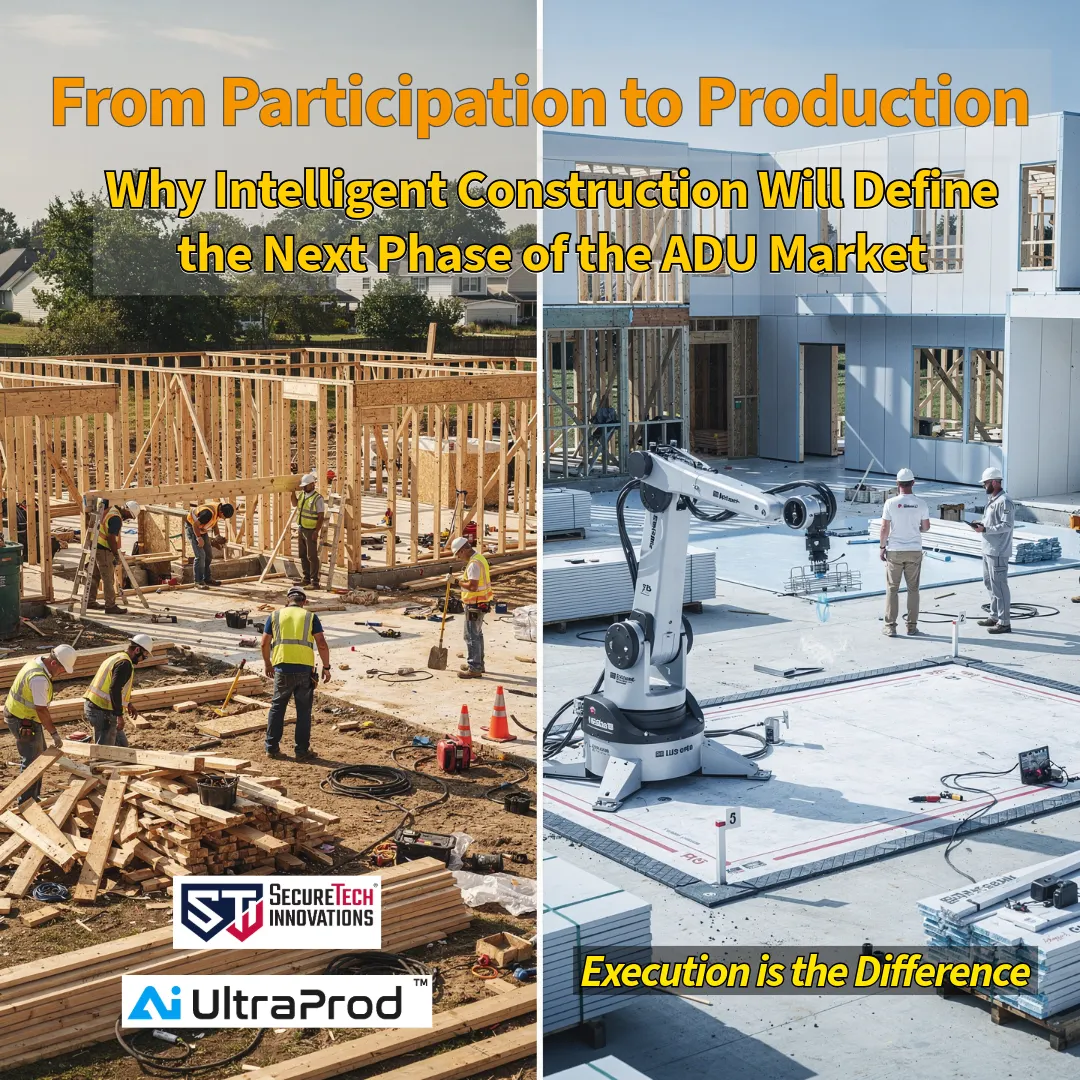
From Participation to Production: Why Intelligent Construction Will Define the Next Phase of the ADU Market
The Shift from Policy Momentum to Scalable Housing Delivery; The Execution Phase Has Arrived
Over the past several years, Accessory Dwelling Units (ADUs) have transitioned from policy aspiration to policy reality across much of the United States. As documented in recent reporting from Maine, Massachusetts, Kentucky, and California, the question facing communities is no longer whether ADUs should be permitted, but how they can be delivered efficiently, compliantly, and at scale.
This shift marks a critical inflection point for the housing market. As “By-Right, Backyard, and Big Business: The South Shore’s ADU Shift” makes clear, zoning barriers are falling, and permit activity is rising, with some municipalities reporting a tripling of ADU applications in a single year. At the same time, local leaders are voicing concerns about execution capacity, regulatory consistency, and long-term market impacts.
From SecureTech Innovations’ (SecureTech) perspective, these signals confirm that the ADU market has entered its execution phase, following the market’s shift from permission to participation. Demand is present. Policy frameworks are expanding. What remains unresolved is delivery.
The Emerging Constraint: Execution Capacity
Multiple articles from early January 2026 point to the same underlying friction: while ADUs are increasingly permitted, delivery remains constrained. In Kentucky, “What is an accessory dwelling unit? What to know before building in Kentucky”, outlines the practical challenges homeowners face even after authorization. Conditional use permits, site-plan review, zoning interpretation, and construction timelines continue to slow progress. In Dalton, Massachusetts, “Despite support from new town manager, moveable tiny homes are still not ADUs” illustrates how legal definitions and code compliance can limit what is actually built. This is regardless of local appetite or leadership support.
These execution constraints are not confined to states with restrictive zoning. Even in California, where state law increasingly mandates local acceptance, municipalities are grappling with second-order effects. The Sebastopol City Council’s approval of its first ADU condominium conversion was driven largely by state-level housing mandates, with officials openly acknowledging uncertainty around precedent and long-term implications. Policy momentum, in other words, is moving faster than delivery infrastructure.
At the same time, the reporting makes clear why traditional construction models struggle to close this gap. The ADU market is not being led by national homebuilders, but by homeowners, regional contractors, and small developers. This segment faces structural limitations, including skilled labor shortages, fragmented trade coordination, long construction timelines relative to unit size, and high variability in cost, schedule, and outcomes. Even as firms like ING Construction and Development strengthen project management frameworks to improve transparency and accountability in markets like Los Angeles, the underlying delivery model remains labor-intensive and sequential.
In short, while the market is authorized to build, it’s not yet optimized to build. In other words, execution, not policy, now defines outcomes. This is the gap where intelligent construction becomes decisive.
AI UltraProd: Re-Architecting Construction for the ADU Era
AI UltraProd, a wholly owned subsidiary of SecureTech Innovations (SCTH), was built specifically to address the execution constraints now defining the U.S. ADU market.
At the core of AI UltraProd’s platform is an AI-driven, multi-degree-of-freedom robotic 3D printing system designed for on-site construction. Unlike gantry-based printers or modular prefabrication systems constrained by transport logistics, AI UltraProd’s robotic arms dynamically adjust motion paths, material flow, and geometry in real time. Thus, responding to site conditions while maintaining precision and repeatability.
This approach directly addresses the realities surfaced in recent reporting:
- Speed and predictability in markets where permitting is already approved but timelines remain uncertain
- Consistency and compliance in jurisdictions navigating complex legal definitions, as highlighted in Dalton and Sebastopol
- Scalable capacity for homeowners and small builders now entering the ADU market in large numbers
Materials Science as a Competitive Advantage
Execution speed alone is insufficient if durability and code compliance are compromised. AI UltraProd’s proprietary ultra-high-performance concrete (UHPC) composite formulation enables thinner wall profiles, higher structural strength, and reduced material waste, all without sacrificing regulatory acceptance. This matters in markets like California and Massachusetts, where inspection standards are rigorous, and municipalities are increasingly sensitive to long-term building performance. As architectural projects like the Ivan Hill ADU Residence demonstrate, quality, permanence, and livability are now baseline expectations — not optional upgrades.
AI UltraProd’s material science is designed to meet those expectations while enabling faster, more repeatable delivery.
Patent-Backed Differentiation in a Crowded Innovation Landscape
AI UltraProd’s platform is protected by a growing portfolio of patents spanning:
- Robotic motion control and multi-axis construction
- AI-driven manufacturing intelligence
- Advanced composite material formulations
This intellectual property foundation is critical as ADUs attract greater capital attention. As the South Shore article notes, investor interest is rising alongside policy reform. In such an environment, defensible technology becomes the primary differentiator, not incremental process improvement.
From Backyard ADUs to Broader Real Estate Delivery
One of the most consistent insights across the eight articles is who is actually delivering ADUs: homeowners, small builders, and regional contractors. It is these actors who are carrying the weight of ADU production across most U.S. markets — not large national developers. In this case, AI UltraProd is perfectly designed to empower small builders and regional contractors, not replace them.
By compressing timelines, reducing labor dependency, and standardizing outcomes, AI UltraProd enables more units to be delivered per year without proportionally increasing overhead or complexity. This is also achievable, at scale, without becoming (or less of) an eyesore or public nuisance. In effect, AI UltraProd provides execution infrastructure for a market that has already secured permission.
While ADUs represent a clear entry point, it is important to understand that the implications of intelligent construction extend well beyond backyard housing. The same execution challenges of labor constraints, cost volatility, and compliance risk apply across small-scale residential and infill development more broadly. As states continue to push density, infill, and housing diversification, intelligent construction platforms capable of operating within regulatory boundaries are likely to become increasingly valuable across the broader real estate market.
A Defining Moment for Housing Delivery
The reporting from January 4–9, 2026, reveals a housing market that has already completed much of the political and regulatory work required to expand ADU supply. What remains is execution discipline.
From SecureTech’s perspective, this is where the next phase of housing innovation will be defined. We do not believe it will come through additional zoning reform alone. Rather, innovations in housing will be delivered by technologies that can reliably and efficiently convert approval into occupancy. Execution will determine the winners!
AI UltraProd was built for that moment. That moment appears to be upon us.
—
AI UltraProd isn’t a concept! It’s real. It’s intelligent. And it’s operational — already generating seven-figure revenues.
An Executive Thought Leadership Blog, By: J. Scott Sitra, President & CEO
For inquiries, collaboration, or strategic interest, contact: