
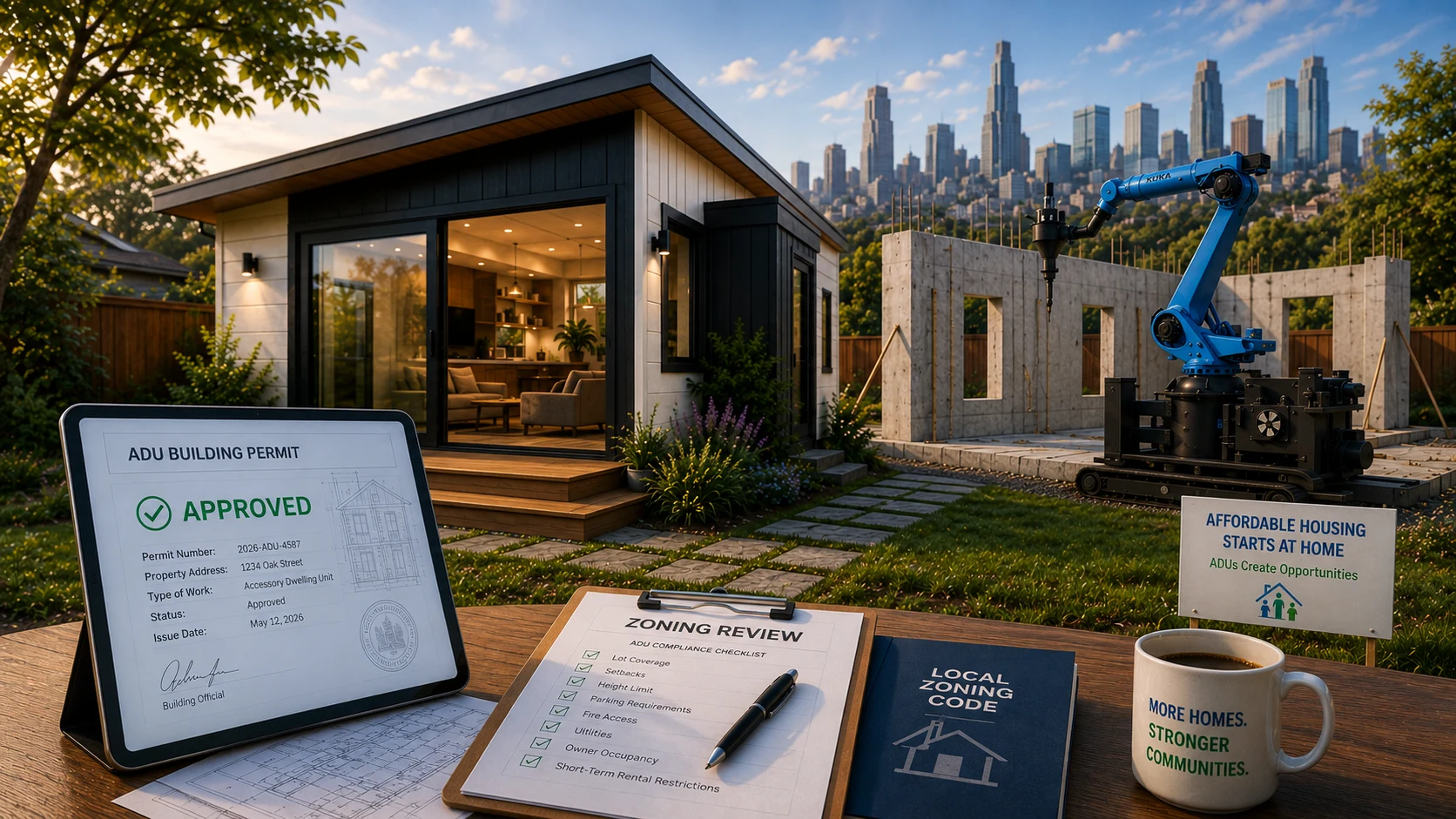
A Market-Facing Review of ADU Trends and Challenges Across U.S. Jurisdictions
Accessory Dwelling Units (ADUs) have evolved from niche housing solutions into an increasingly prominent focus of housing policy and market innovation in many parts of the United States. In 2026, legislative action, regulatory reform, and growing consumer demand are reshaping the landscape for these small, self-contained homes. Today, we’re highlighting developments across multiple states and municipalities that illustrate several common themes, market drivers, and ongoing challenges influencing the ADU sector.
Policy Momentum and Regulatory Change
The past year has brought a wave of legislative and regulatory activity designed to expand ADU adoption. States and municipalities increasingly view ADUs as a practical response to housing shortages, affordability pressures, and changing demographic needs. A central theme is simplifying permitting processes that have historically limited ADU development through variances, special approvals, and lengthy hearings.
In Virginia, Richmond’s city council amended its zoning code in 2023 to significantly expand where ADUs are allowed by right in residential areas, contributing to a noticeable increase in permit applications. Local reporting indicates that on the order of 100+ ADU permits have been issued since the change, with a single developer responsible for a substantial share. State‑level policymakers have also been considering legislation that would require more localities to allow ADUs by right over the next several years, though the scope and timing of any statewide mandate continue to evolve and may differ by locality.
Pennsylvania is pursuing similar reforms. In the 2023–2024 session, the state House advanced HB 2186 with bipartisan support; the proposal would require many municipalities to allow at least one ADU per residential lot by right and would reduce some local zoning barriers and approval delays. As drafted, the bill would establish a statewide baseline for ADU approval while still leaving municipalities with certain powers over local standards and short‑term rental rules. Legislative status and specific provisions remain subject to change as the bill progresses. The approach mirrors reforms adopted in California, where ADU construction has expanded significantly.
At the local level, Gulfport, Florida, is refining its ADU ordinance to create a clearer path for homeowners while addressing community concerns. The proposal includes owner‑occupancy requirements and size limits. City staff have indicated that ADU uptake is likely to be gradual over time rather than explosive. Gulfport’s approach also reflects caution in flood‑prone areas, where officials are evaluating how ADUs interact with flood‑hazard regulations and insurance considerations before allowing broader development. The city also uses its zoning and rental ordinances to limit the use of ADUs as short‑term rentals and notes that private restrictive covenants in some neighborhoods may further restrict these uses.
California continues refining its ADU framework through expedited review requirements and protections for certain ADU types, although local complexities remain. Cities such as Bend, Oregon, are also encouraging adoption through pre-approved ADU plans that reduce permitting friction and accelerate approvals.
Even where state mandates exist, implementation can remain complicated. In California, including jurisdictions such as Santa Barbara, property owners must still address requirements related to setbacks, height, fire access, parking, and utility connections when developing ADUs. These standards can differ by city and property type, reinforcing the need for careful planning and professional guidance. While legislative momentum continues to build nationwide, the effectiveness of these reforms will depend on how consistently they are implemented at the local level.
ADUs as a Flexible Response to Housing Needs
Policymakers and developers increasingly view ADUs as a flexible solution to multiple housing challenges. By allowing small, self-contained units on existing residential lots, ADUs can expand housing supply without large-scale development or significant land consumption.
In Richmond, some ADUs aimed at low‑income renters and voucher holders have been developed using accelerated construction methods, with certain projects reportedly completed in as little as 60 to 70 days once on‑site work begins. Developers see ADUs as an efficient way to deliver affordable housing quickly. In Santa Barbara, ADUs support families, students, and aging residents, helping promote multigenerational living and workforce retention.
Gulfport’s ordinance is tied to workforce and in-law housing objectives, with city leaders emphasizing benefits for aging residents and households seeking flexible living arrangements. Pennsylvania’s legislative effort is similarly framed as a response to statewide housing shortages, with advocates highlighting affordability and property-rights benefits.
Local Concerns: Parking, Neighborhood Character, and Short-Term Rentals
Despite broad policy support, local concerns continue to influence ADU implementation. Residents and officials frequently raise questions about parking, density, stormwater management, and the potential conversion of ADUs into short-term rentals.
Gulfport’s impact assessment identified parking as the most significant neighborhood-level concern, although projections suggest ADU growth will remain gradual. The city’s ordinance includes an 800-square-foot size cap and restrictions on short-term rentals.
In Richmond, reactions to ADU development vary. Some residents express concerns about privacy and neighborhood character, while others remain supportive or indifferent. In California, some cities have adopted local ordinances that limit the use of ADUs as short‑term rentals in order to preserve long‑term housing; although these rules vary widely by jurisdiction and are not uniform under state law.
These issues underscore the importance of clear regulations, effective enforcement, and ongoing community engagement.
Innovation in ADU Delivery and Implementation Realities
To accelerate adoption and reduce barriers, municipalities and developers are experimenting with new delivery models. Bend, Oregon, has released four free pre-approved ADU plans, including accessible studios and two-bedroom layouts. The initiative simplifies design and permitting for property owners.
Developers in Richmond and Jersey City are also leveraging modular construction and accelerated build schedules. In Richmond, some ADUs can be completed within two months. In Jersey City, a recent condominium project incorporates duplexes alongside smaller accessory‑style units that function similarly to ADUs within the overall development.
These approaches are intended to make ADU development more accessible to a wider range of property owners and investors. However, despite ongoing innovation and strong policy momentum, ADU implementation continues to involve significant complexity. Local requirements governing setbacks, height, parking, fire access, and utilities can vary widely, even within the same state. Flood-zone restrictions, such as those under consideration in Gulfport, add uncertainty related to insurance and community-rating impacts.
In California, property owners must still navigate extensive local regulations and administrative processes despite state-level reforms. ADU projects often require multiple plan reviews, revisions, and coordination among departments and utility providers. Recent legal changes have created new opportunities to legalize older unpermitted units, though health and safety standards remain critical considerations.
Homeowners, buyers, and sellers are encouraged to seek professional guidance early, as ADU projects often involve property-specific challenges that can affect timelines, costs, and feasibility.
So, You Want to Know Our Thoughts, Eh?
As communities across the United States evaluate Accessory Dwelling Units as part of broader housing strategies, the conversation is increasingly moving beyond policy reform. Attention is shifting toward implementation, scalability, and the practical realities of delivering housing efficiently while meeting local requirements and community expectations.
While zoning reform and permitting modernization may unlock new opportunities, successful adoption ultimately depends on moving projects from approval to completion in a predictable, cost-effective manner. This has increased interest in construction technologies, manufacturing methods, and delivery systems that can bring greater consistency to a fragmented housing landscape.
At SecureTech Innovations, we believe these trends underscore the importance of innovation throughout the housing delivery process. Through our subsidiary, AI UltraProd, we continue to monitor the evolving ADU market and the broader shift toward technology-enabled construction, including AI-driven robotic manufacturing and automated building systems.
Although the ADU sector remains in the early stages of development in many jurisdictions — particularly outside of a few early‑adopter states — we believe the growing focus on speed, repeatability, compliance, and cost efficiency may create opportunities for new housing delivery approaches over time. As policymakers, developers, and property owners seek solutions to housing supply challenges, we expect innovation to remain central to that discussion.
We remain focused on advancing technologies that support more efficient construction workflows while evaluating opportunities for future partnerships, commercial applications, and long-term participation in emerging housing markets and broader commercial real estate opportunities.