
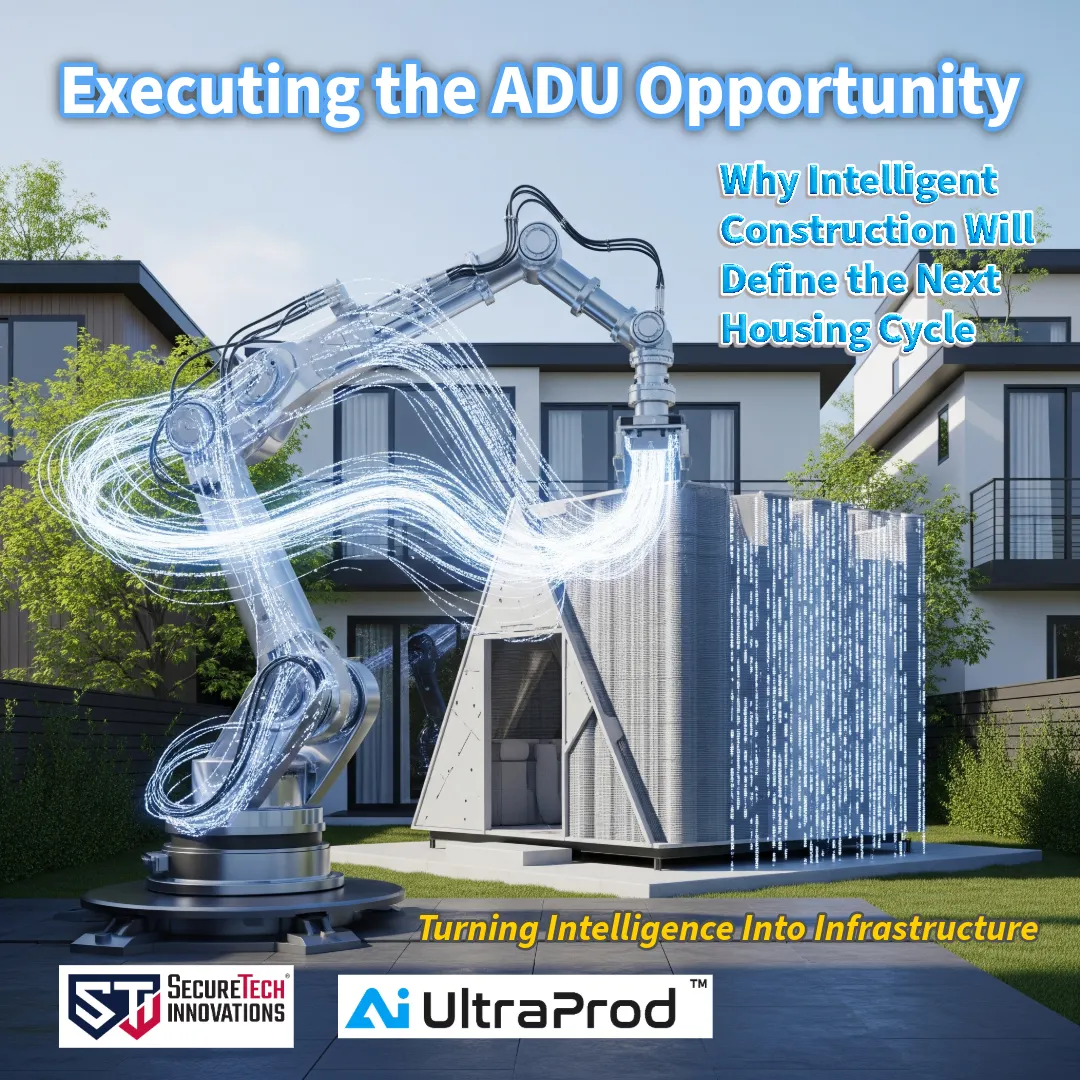
Executing the ADU Opportunity: Why Intelligent Construction Will Define the Next Housing Cycle
Meeting the Execution Imperative with AI-Driven Robotic Construction
By the close of 2025, one reality had become clear across U.S. housing markets: Accessory Dwelling Units are no longer a speculative policy experiment. They are a sanctioned, increasingly relied-upon form of housing delivery. Yet as year‑end [2025] reporting makes evident, authorization alone is not producing housing at the pace communities require. What separates intention from outcome is execution.
Across jurisdictions, policymakers have largely done their part. Cities like St. Louis are expanding ADU eligibility through land‑use amendments. States such as Maine are investing in homeowner education. New York City has opened pathways for backyard units, while communities like New Bedford and Ashland increasingly frame ADUs as pragmatic affordability tools. Post‑disaster rebuilding in Superior, Colorado, underscores the urgency of restoring housing quickly within existing neighborhoods.
What these developments collectively signal is not a lack of demand, but a delivery challenge. Reporting from Berkshire County and Dalton highlights cost uncertainty, regulatory nuance, and construction complexity that continue to slow progress even where intent is strong. ADUs may not be a silver bullet, but their success now hinges on reliable, repeatable execution models.
This transition mirrors the policy-to-practice shift examined in From Policy Momentum to Practical Infill: What Recent ADU Developments Reveal About U.S. Housing, as ADUs move from permission toward production.
This is where AI UltraProd’s role becomes distinct.
AI UltraProd was not designed to incrementally improve traditional construction workflows. It was designed to re-architect them.
Its core technology centers on AI-driven, multi-degree-of-freedom robotic 3D printing arms capable of adaptive, on-site fabrication. Unlike gantry-based printers or modular systems constrained by transport and assembly, AI UltraProd’s robotic arms dynamically adjust motion, material flow, and geometry in real time — responding to site conditions while maintaining precision and repeatability.
This capability directly addresses the constraints surfaced in recent reporting. Small builders and micro-developers, who were highlighted implicitly in articles on best ADU builders, small-lot proposals in Hollywood, and post-fire rebuilding efforts, do not need more paperwork or broader zoning allowances. What they need is more capacity. AI UltraProd multiplies capacity by reducing labor dependency, compressing construction timelines, and standardizing outcomes without sacrificing customization.
Equally critical is materials science.
Speed without durability undermines regulatory trust and community acceptance. AI UltraProd’s proprietary ultra-high-performance concrete (UHPC) composite enables thinner wall profiles, greater structural strength, and significantly reduced material waste. This aligns directly with the emphasis on resilience, longevity, and environmental responsibility embedded in grant programs, zoning reforms, and rebuilding initiatives described across year-end reporting.
Patents spanning robotic motion, AI manufacturing intelligence, and advanced composite formulations provide AI UltraProd with defensible differentiation. In a market where municipalities are cautious, which was illustrated by Dalton’s exclusion of movable tiny homes from ADU definitions and legal scrutiny surrounding oversized projects like the Chalcifica ruling in California, precision and compliance matter as much as speed. AI UltraProd’s system is engineered to deliver within those boundaries, not test them.
Another consistent insight from the market’s reporting is, who is not driving ADU supply: large national developers. Instead, the market depends on homeowners, regional contractors, and small builders. AI UltraProd is not positioned to replace these actors, but to empower them. By lowering execution risk and increasing throughput, the platform enables more units to be delivered per year without proportionally increasing overhead or complexity.
Based on industry reporting, the ADU market has entered its execution phase. Demand is no longer the limiting factor. Participation is forming. Expectations are rising. What remains unresolved is scalable, disciplined delivery.
SecureTech’s strategy reflects that reality.
AI UltraProd operates precisely where zoning, funding mechanisms, and homeowner intent converge with construction discipline. Its AI-driven robotic systems, proprietary materials, and patent-backed processes are not speculative concepts. No…, these are execution tools designed for the constraints and opportunities now defining the U.S. ADU and broader real estate markets.
Fact is, as communities move from approving ADUs ‘in principle’, to expecting results, the question is no longer whether small-scale housing can help address America’s housing challenges. The question is who can, and who will, deliver it consistently, compliantly, and at scale. We believe that answer will be defined by intelligent construction and companies like AI UltraProd, who have built just that.
AI UltraProd isn’t a concept! It’s real. It’s intelligent. And it’s operational — already generating seven-figure revenues.
An Executive Thought Leadership Blog
By: J. Scott Sitra, President & CEO
For inquiries, collaboration, or strategic interest, contact: