
Why Execution Will Define the Next Phase of U.S. Housing
Over the past several weeks, a clear and consistent signal has emerged across housing policy, municipal planning, and local market activity. That is, the question is no longer whether Accessory Dwelling Units (ADUs) will be built, but rather, can they be built efficiently, predictably, and at scale.
From New Hampshire to Idaho, from Santa Barbara to New York City, the regulatory environment is moving deliberately and decisively toward enabling ADU development. As noted in “Bills Aim to Expand Starter Homes, ADUs,” lawmakers, in places like Idaho, are actively reducing zoning barriers and streamlining approvals to stimulate entry-level housing supply. Similarly, “County of Santa Barbara Debuts Pre-Approved ADU Plans for Area Homeowners” reflects a broader effort to simplify compliance and accelerate project initiation.
Even structured programs like the 2026 ADU Lottery Application Cycle (April 1 – May 30) in San Juan County signal something important. Demand is no longer in question. Capacity is.
Yes, The Market Has Aligned… But Delivery Has Not
Across the dataset, one theme is unmistakable. As explored in From Policy Momentum to Practical Infill, policy alignment is already translating into real-world project activity.
For one, policy is aligning, access is expanding, incentives are emerging, and homeowner interest is rising. Yet despite this alignment, the pace of completed ADU delivery remains inconsistent.
Second, municipalities are responding accordingly. Santa Barbara is introducing pre-approved design frameworks to reduce friction, Boise is offering free ADU plans to lower upfront costs, Kingston is hosting ADU expos to educate homeowners and builders, and Jefferson County is exploring AI-assisted permitting tools to address administrative backlog.
Each of these initiatives is attempting to solve the same underlying problem: execution. Just as discussed in When Policy Unlocks Demand, Execution Determines the Winners, the market is no longer constrained by access, but by the ability to deliver.
The gap between approval and completion.
As established in Part 1 of this series, the market has already moved beyond the question of policy permission and into the more complex challenge of execution.
Historically, the housing conversation centered on entitlement, including zoning, approvals, and regulatory permission. Today, that bottleneck has shifted—from the difficulty of getting projects approved to the challenge of executing them reliably across fragmented, real-world conditions.
Across recent reporting, this pattern appears consistently. Permitting timelines remain inconsistent. Construction costs remain volatile. Labor availability remains constrained. Infrastructure such as water, septic, and parking imposes real limits. Administrative capacity is uneven across jurisdictions.
Even where frameworks improve, execution remains largely manual, fragmented, and variable in outcome.
Reframing the Opportunity: From Fragmentation to Infrastructure
One of the most important observations across recent reporting and the broader coverage is this: the ADU market is not being driven by large, centralized developers. Instead, it is driven by homeowners, small builders, regional contractors, and localized development teams. This fragmentation creates opportunity, but it also introduces complexity.
Unlike large-scale developments, ADU projects must adapt to unique site conditions, varied regulatory interpretations, differing contractor capabilities, and inconsistent timelines. In this environment, scalability is not simply a function of demand. It is a function of execution consistency.
That is why the market is not currently lacking demand, policy support, or conceptual frameworks. What it lacks is infrastructure for execution. We are not referring to physical infrastructure in the traditional sense. Rather, this is process infrastructure, and process infrastructure includes systems that reduce variability, methods that compress timelines, technologies that standardize outcomes, and platforms that enable fragmented participants to operate more efficiently.
The ADU opportunity that seems to be rapidly taking share across the U.S. is not simply about building more units, but about constructing a more reliable way to efficiently build them.
Where AI UltraProd Fits
At SecureTech Innovations, we have spent considerable time analyzing not just the ADU market, but the conditions required for it to scale.
Our conclusion aligns directly with what is now emerging across the country.
The next phase of housing growth will be defined by execution systems, not policy frameworks.
AI UltraProd was developed with that reality in mind; not just in the U.S., but across the world.
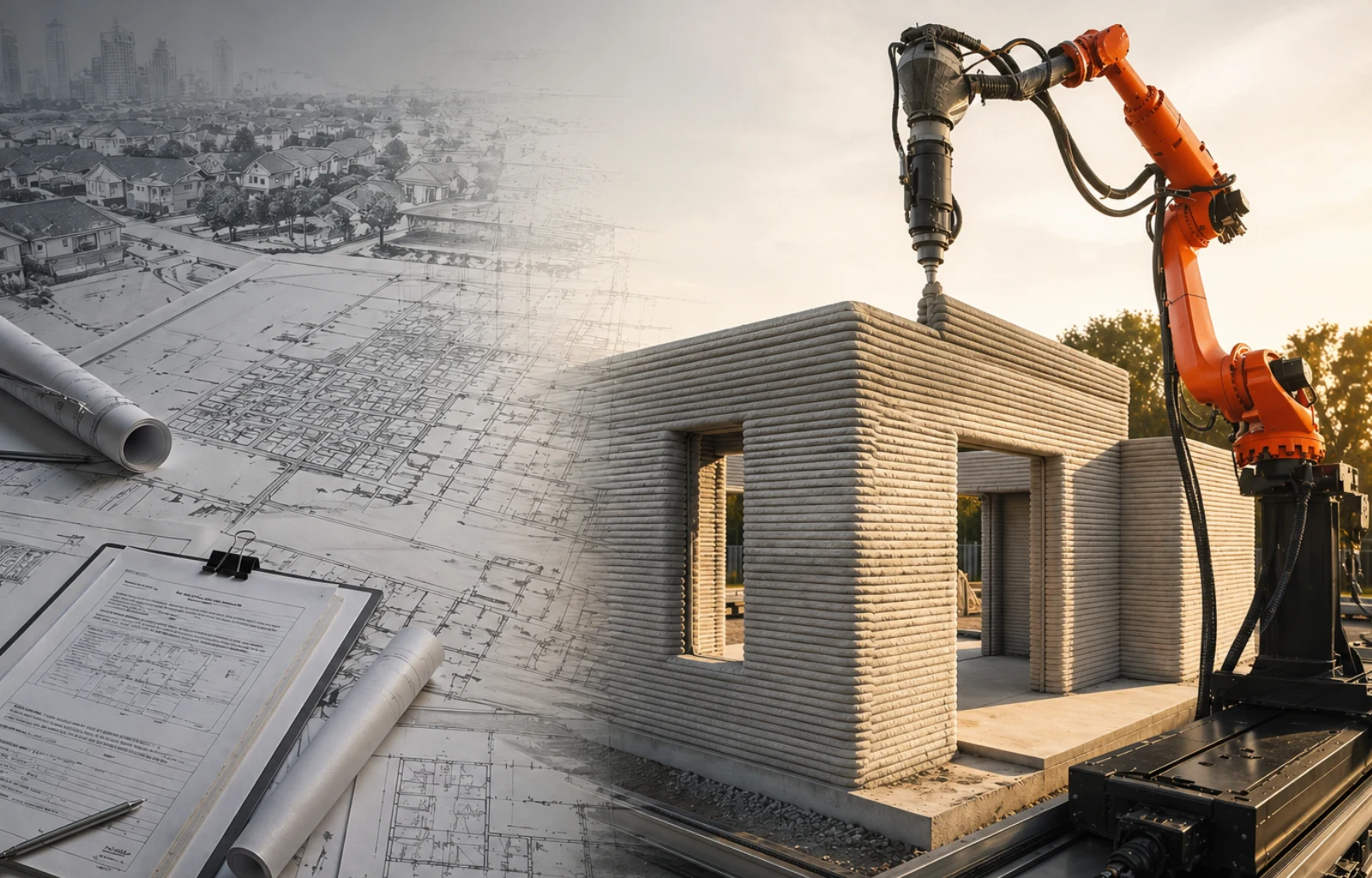
AI UltraProd is not positioned as a traditional construction company, or a construction company at all, for that matter. It is designed as a construction-enablement platform efficiently powered by AI-driven robotic systems, on-site 3D printing capabilities, proprietary material science, and patent-backed process control.
At its core, the system translates architectural and structural designs into machine-executable instructions, deploys robotic arms capable of precise, continuous-layer construction, and utilizes engineered concrete mixtures optimized for strength, efficiency, and reduced waste. The result is a build process that can achieve a high degree of repeatability, even across variable site conditions, at a fraction of the cost. And for clarity, this does not mean a loss of jobs. It means more work sites operating more efficiently, allowing more work, more often.
You see, the objective is not simply speed and significantly reduced cost. It is precision, consistency, and scalability with greater margins.
This matters now because the alignment between AI UltraProd’s capabilities and current market conditions is not coincidental. It is structural. The same issues identified across recent reporting, including permitting delays, cost unpredictability, labor constraints, and execution variability, are precisely the variables that AI-driven construction seeks to address.
In a market where municipalities are introducing pre-approved plans, homeowners are seeking predictable outcomes, and regulators are emphasizing compliance and durability, the value of repeatable, code-conscious construction methods increases significantly.
Beyond ADUs: A Broader Real Estate Implication
While ADUs serve as the immediate lens through which these dynamics are visible, the underlying challenges are not confined to backyard housing.
The same execution constraints exist across starter homes, small-lot developments, workforce housing, missing-middle housing formats, and post-disaster reconstruction. What the ADU market represents is not just a segment. It is a signal.
Small-scale, distributed housing requires a different construction paradigm than traditional large-scale development.
The past several weeks of developments make one thing clear: the U.S. housing market, particularly within the ADU segment, has crossed an important threshold. Permission is expanding, interest is rising, and frameworks are forming.
But without a corresponding evolution in how housing is delivered, these gains risk being constrained by execution. That is why the ADU market matters beyond ADUs themselves. It reveals a broader truth about small-scale, distributed housing.
Recent Market Signals
Recent reporting continues to reinforce a consistent pattern across housing policy, planning, and real-world development activity.
- Policy expansion is accelerating nationally, but outcomes remain uncertain. States like Virginia and Idaho are mandating ADU-by-right construction and removing zoning barriers, while regions like Maine are still unable to determine whether similar reforms are translating into actual housing delivery.
- Municipalities are actively building support systems—designs, financing, and education—but not delivery infrastructure. Programs in Long Beach, Santa Barbara County, Ulster County, and East Hampton are offering pre-approved plans, subsidized loans, and technical guidance, yet these initiatives are focused on enabling projects, not ensuring consistent execution.
- Execution remains fragmented across real-world conditions, even as demand scales. From disaster recovery deployments in California to rural compliance challenges in Washington and localized contractor-led build models, ADU production continues to depend on highly variable site conditions, permitting environments, and contractor capabilities.
Together, these signals reinforce the central dynamic of this analysis. That is, while access to build has expanded, the ability to deliver consistently at scale remains unresolved. This is where AI UltraProd comes in.
AI UltraProd isn’t a concept. It’s real. It’s intelligent. And it’s operational — already generating seven-figure revenues.
Closing Perspective
The ADU opportunity is real. The policy momentum is real. The demand is real.
But the defining challenge of this moment is not access. It is delivery.
The future of housing will not be determined by who can approve projects, but by who can build them consistently and at scale. We believe AI UltraProd is well-positioned to be a strong national contender to do just that.
For inquiries, collaboration, or strategic interest, contact: ir@securetechinnovations.com