
Disaster recovery depends on preparing housing, construction capacity, and approval pathways before communities need them
California began preparing for a difficult storm season before its full effects were known. On September 21, Governor Gavin Newsom proclaimed a statewide emergency to mobilize resources ahead of a potentially severe El Niño fall and winter.
State agencies are staging flood-fighting supplies, preparing roads and critical infrastructure, and coordinating with local governments to reduce risks from flooding, landslides, and coastal hazards. NOAA’s Climate Prediction Center said in its Sep 10, 2026 ENSO Diagnostic Discussion that El Niño was strengthening, with a greater than 90% chance of a very strong event during the 2026-27 fall and winter seasons.
(Note: That forecast describes a broad climate pattern, not the timing, location, or severity of storms in a particular community.)
The immediate priority is clear: protect lives, help residents understand their risks, and equip responders to act. Of course, we cannot presume which communities will suffer damage or how extensive that damage might be. Yet still, that raises a longer-range question. If homes and community facilities must eventually be rebuilt, how much of that work can be organized before a disaster occurs? And perhaps equally important, how quickly can rebuilding solutions be deployed?
At SecureTech Innovations, we have come to believe that recovery planning should include the capacity to rebuild efficiently. It means understanding where housing can be built safely, what types of designs might be appropriate, how materials and crews could be mobilized effectively, which construction methods could shorten specific phases, and which approvals would be required. Emerging construction methods, including digital design, modular production, and robotic 3D printing, may offer additional options. Their technological value in a recovery setting depends on whether those options have been evaluated and made practical in advance.
Recovery Has More Than One Timeline
The first days after a disaster center on safety, shelter, and essential services. Recovery then requires interim housing, repair, permanent rebuilding, or relocation where risk remains. Renters, lower-income households, older residents, and people with disabilities may need affordable, accessible options for longer. Communities must also restore housing, schools, clinics, and utilities while workforce and supply chains are disrupted.
A printed wall is not a finished home. A rapid building method cannot, on its own, establish a safe site, reconnect utilities, resolve an insurance claim, or secure a permit. Even when it shortens one phase, the broader schedule still depends on land, financing, inspection, and the people who make these systems work.
That is why the Federal Emergency Management Agency includes pre-disaster recovery planning in its guidance for local governments. Planning before an event gives officials and community partners a chance to establish roles and priorities while they have more time and better information. Housing deserves particular attention because displacement can continue long after emergency response has ended.
We see this as a useful starting point for the construction industry as well. If a community waits until significant damage occurs to decide how a new building method will be designed, tested, procured, approved, and implemented, it may be too late for that method to help on the timeline residents need.
Prepare Choices Before They Become Urgent
Advance planning does not require a community to select one technology or prescribe the same replacement home for every family. It requires a set of credible choices. In California, for example, this work can build on local general plans, including their safety and housing elements, as well as hazard-mitigation and recovery plans. Those tools can help align housing needs, land use, infrastructure, and decisions about where rebuilding is safe.
Site selection comes first. Rebuilding on flood-prone or unstable land, or where infrastructure remains vulnerable, may recreate the loss. Local leaders and qualified professionals must weigh hazards, suitable land, and residents’ limited relocation options.
Adaptable plans for homes or small community facilities can address structure, accessibility, utilities, and climate before construction is urgent. Digital models can help teams revise designs, while 3D printing and robotics may shorten specific fabrication or wall-production tasks. Each building still requires site-specific review.
Production is another part of readiness. Materials may be locally available, need to be shipped in, or require specialized preparation. Equipment needs a workable site, power, operators, maintenance, and quality controls. Public agencies can also plan how to contract for qualified design, inspection, materials, and construction services, and whether mutual-aid agreements could expand capacity. Prefabricated components may be useful where site access is poor; on-site production may fit different conditions. Understanding those tradeoffs before a disaster can help decision-makers select a method for the problem in front of them, rather than adapting the problem to the equipment at hand.
Finally, communities need an approval and funding pathway. Building officials, engineers, insurers, lenders, and recovery agencies may all need different evidence. California’s statewide emergency proclamation is a state preparedness measure, distinct from a federal major-disaster declaration; it does not itself allocate federal recovery money. Community Development Block Grant Disaster Recovery (CDBG-DR) funding depends on a congressional appropriation for eligible disasters, HUD allocation and program requirements, and an approved grantee action plan for eligible disaster-related activities. A potential future funding source should never be mistaken for money already committed to a particular project.
Where Digital Construction May Contribute
Our subsidiary, AI UltraProd (AiUP), has explored 3D-printed buildings for post-disaster reconstruction. They’ve considered how digital designs, modular approaches, and automated construction might help address workforce and logistical pressures in rebuilding. As the AiUP article acknowledges, “Real-world barriers remain: power supply, operator training and incomplete building-code frameworks.” Recovery planning must address those barriers in advance.
The ability to retain and adapt a digital design could be useful when a community needs several buildings that share requirements but differ in layout or site conditions. Robotic deposition may reduce some repetitive work involved in producing certain components. Modular and hybrid building strategies could give teams options for making parts away from a damaged site and assembling them where they are needed. Those options may shorten specific construction phases in suitable projects, but the speed of printing walls does not establish the delivery time for a finished home.
SecureTech’s fiscal 2025 Form 10-K (Business section, p. 9) describes AI UltraProd’s 3D printing robots, digital design solutions, and materials.
The Standard Is a Safe, Finished Building
An emerging method must earn confidence through evidence. Strength measured in a material specimen does not answer every question about a full wall, its connections, or the building around it. Fire resistance, weather protection, accessibility, and durability must be evaluated at the appropriate assembly or building level. The same care applies to assertions about cost and insurance, as project economics and insurer decisions depend on what is actually built, where it is located, and how its performance is documented.
There is progress in creating a common technical framework. The International Code Council’s ICC 1150-2026, Standard for Automated Construction Technology for 3D Printing Walls, sets minimum requirements for material qualification, inspection, structural design, and connections in certain 3D-printed concrete wall systems. ICC says the standard received ANSI approval on Jul 15, 2026. Publication or ANSI approval does not itself establish local code adoption or approve a specific project, product, or design; project-specific engineering and local review still matter.
Testing and approval may look slow beside a demonstration video, but they make the method usable and trustworthy for residents.
The same discipline should guide resilience. A wall’s strength alone cannot make a home flood-safe if the site remains exposed, nor can it ensure recovery if roads, power, and water remain unavailable. A resilient rebuilding plan must address the whole building, the site, and surrounding infrastructure. It may call for a different location, elevated systems, improved drainage, changes to the building envelope, or other measures appropriate to the local hazard.
Technology truly has a role when it serves that larger plan.
Make Rebuilding Capacity Part of Preparedness
California’s early action offers a timely reminder that preparation is most valuable while there is still room to make deliberate choices. We cannot predict which homes will need repair or replacement after a future storm season. What we can do, however, is ask whether communities have examined their housing vulnerabilities and whether new construction methods have been evaluated before circumstances make every decision urgent.
For us, the opportunity is to help AI UltraProd continue developing construction tools and technologies with potential applications in the United States and other markets. Their use in recovery must be assessed honestly and integrated with suitable sites, designs, standards, trained people, and approval pathways. Working with public agencies, builders, engineers, and community partners, we want those capabilities to support a credible path from emergency shelter to safe, durable housing while reducing the risk that rebuilding recreates the same vulnerabilities.
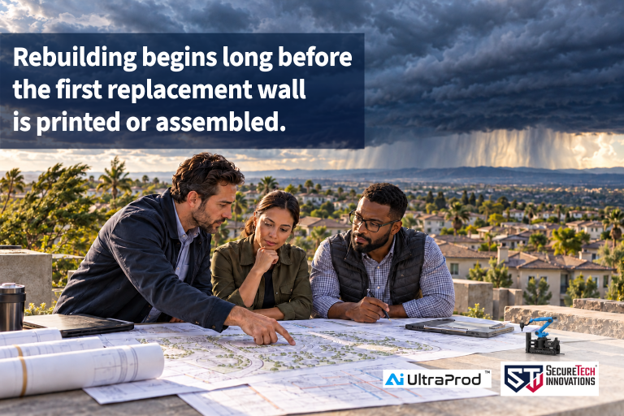
Fact is, rebuilding begins long before the first replacement wall is printed or assembled. It begins when communities decide what they would need to build well, and prepare in advance to do it.
An Executive Thought Leadership Blog
By: J. Scott Sitra, President/CEO
For inquiries, collaboration, or strategic interest, contact:
ir@securetechinnovations.com