
Innovation, Adoption, and Housing Delivery in the Next Phase of Small-Scale Housing
In many parts of the United States, the landscape for Accessory Dwelling Units (ADUs) is changing rapidly. Once relegated to the margins of urban planning and residential development, ADUs, which are sometimes called “granny flats,” “garden cottages,” or “backyard homes”, have become an important focus within policy debates, design innovation, and conversations about housing affordability and urban resilience.
As housing shortages intensify and affordability challenges mount, policymakers, homeowners, and industry leaders are re-examining ADUs as a flexible and accessible housing solution. As discussed in our prior review, Accessory Dwelling Units in 2026: Policy Shifts, Market Dynamics, and Implementation Realities, recent reporting from a growing number of cities and states points to a notable trend: ADUs are gaining ground as both a practical and innovative response to housing needs in many communities.
Regulatory Evolution: From Local Barriers to Statewide Reform
One of the most significant shifts in the ADU landscape is the wave of regulatory reform sweeping across states and municipalities. In California, Placer County is updating its ADU ordinance to better align with recent state law changes. These updates are expected to expand where ADUs are allowed and to adjust standards such as parking, occupancy, and approvals, in part by incorporating state code language directly so the local rules can track future regulatory changes.
North Carolina is considering similar statewide reforms. Senate Bill 445, as introduced, would require larger cities and counties to allow at least one ADU on most single-family lots and would limit some common local barriers such as parking mandates, high fees, and tight size caps. Supporters frame the bill as part of a broader effort to reduce the state’s housing shortfall, which several analyses suggest imposes substantial, multibillion‑dollar economic costs over time.
Elsewhere, Arkansas adopted statewide legislation in 2025 that authorizes and standardizes local regulation of ADUs, marking a notable shift for the state toward supporting small‑scale infill housing. In Santa Rosa, California, officials are exploring policies that would allow ADUs to be sold as condominiums and support targeted upzoning, expanding both rental and ownership opportunities.
These reforms are not uniform, and local adaptation remains essential. In Suffolk County, New York, towns are revising ADU rules to reduce parking requirements, permit larger units, and streamline applications, while the Town of Islip continues to weigh affordability, neighborhood character, and public safety concerns. In Pagosa Springs and Archuleta County, Colorado, updates to community plans and land-use codes are underway, with ADUs viewed as a tool for addressing persistent housing needs.
ADUs as a Solution to Housing Affordability and Supply
At the heart of the ADU movement is the search for practical solutions to housing shortages. ADUs can increase housing supply with relatively less large-scale new development by making more intensive use of existing lots and infrastructure. They provide more affordable options for renters, generate supplemental income for homeowners, and support multigenerational living.
In Suffolk County, many housing advocates and local officials describe ADUs as an important tool. ADUs can potentially help seniors, working families, and young residents remain in their communities despite rising housing costs, even as other stakeholders continue to raise concerns about neighborhood impacts. Some recent analyses, including work referenced by the Federal Housing Finance Agency, suggest that adding legal ADUs can be associated with higher property values in certain markets. However, the impact on nearby homes varies by local context and regulation, and is not uniform nationwide. Commentators in Colorado and California note that many ADUs are financed directly by homeowners, often through savings or home equity, with limited reliance on traditional public subsidy programs. At the same time, some jurisdictions are piloting grants, loans, fee waivers, or other incentives to encourage ADU production, particularly for income‑restricted units.
However, financing remains a significant barrier, with most homeowners relying on savings or property equity. In Pagosa Springs, local survey data suggest strong demand for smaller, one-bedroom homes among many residents. However, zoning and land-use codes often continue to seemingly favor lower-density patterns and larger housing formats, creating a mismatch between existing regulations and expressed housing needs. This disconnect between housing demand and regulation remains a recurring theme.
Community Engagement and Local Adaptation
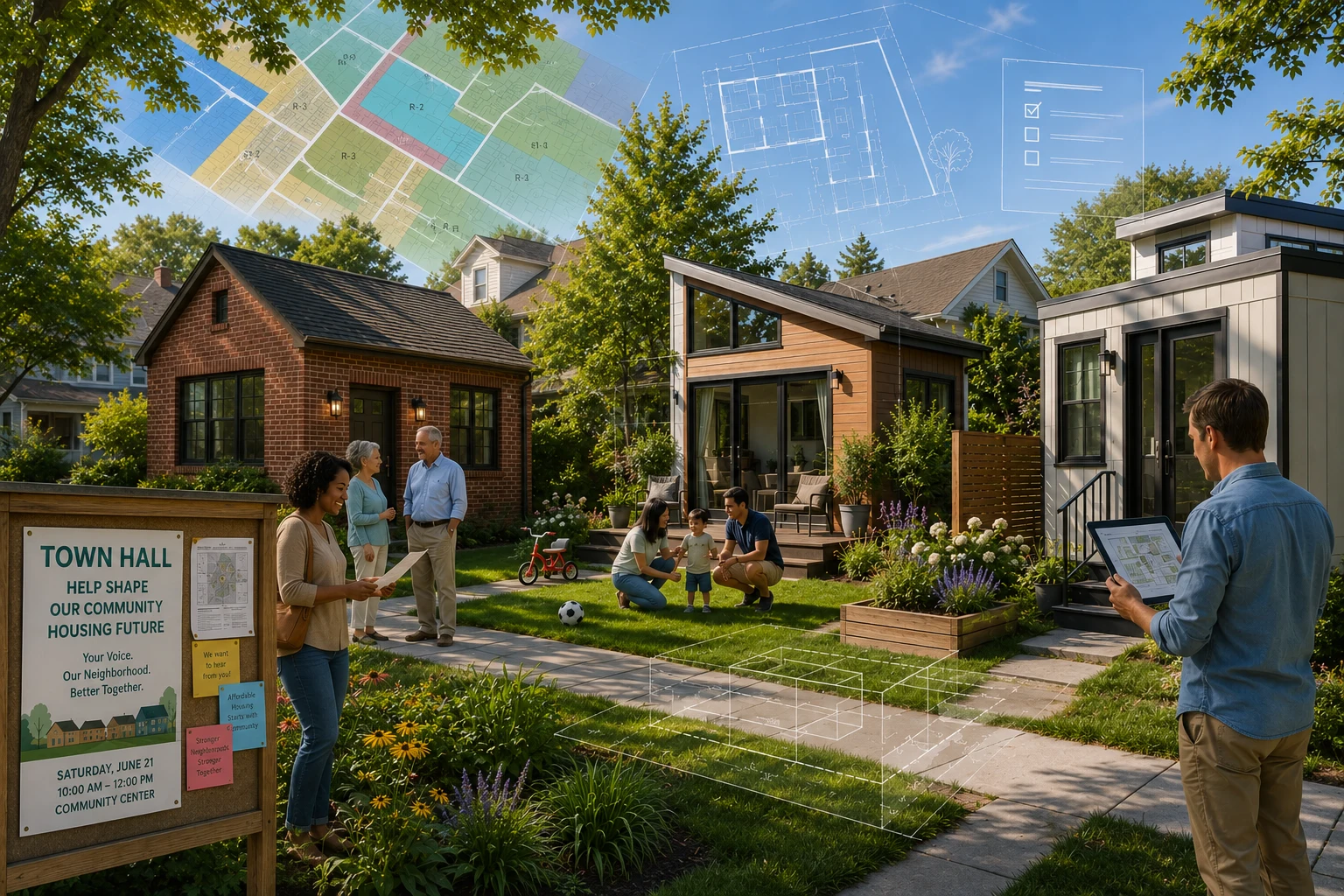
Updating ADU policies is rarely straightforward. Community engagement is essential to ensure new rules reflect local priorities and build support for change. Birmingham, Alabama, is holding town halls before drafting its first ADU ordinance. Residents have expressed support for increased income opportunities and accessible housing while raising concerns about property taxes, short-term rentals, absentee landlords, and parking.
Santa Rosa’s efforts to allow ADU sales and upzoning require extensive analysis and public input. Converting an ADU into a condominium can involve legal agreements, utility upgrades, and coordination among multiple stakeholders, underscoring the need for careful planning and transparent communication.
Even in smaller communities, updates to community plans and land-use codes prompt broader discussions about density, affordability, and neighborhood character.
Innovation Across Design, Construction, and Planning
ADUs are not just a policy solution; they are also a platform for innovation.
In Bentonville, Arkansas, a lofted ADU built with triple-wythe structural brick masonry incorporated a salvaged historic white oak arched door as a defining feature. The project demonstrates that traditional building methods can remain economically viable and code-compliant while offering alternatives where modular construction faces site-access limitations.
In Los Angeles, a family transformed their ADU into a hybrid home and coffee shop that quickly attracted community support. The project highlights the flexibility and entrepreneurial potential of ADUs; functioning as residences, businesses, or both.
Together, these examples show how ADUs can serve as laboratories for adaptive reuse, multifunctional design, and varied construction approaches. As adoption grows, development models are likely to expand, generating lessons for policymakers and practitioners.
Technology is also becoming increasingly important. As with AI UltraProd’s AI-driven 3D printing robotic construction platform, other emerging digital platforms, such as Buildability, aim to simplify planning for home additions and ADUs. Their indicated intent is to give homeowners preliminary insight into site constraints and opportunities before committing significant time or capital. As these tools evolve, their specific features and coverage areas may change.
Although still evolving, digital solutions can reduce complexity by consolidating regulatory information, streamlining assessments, and improving accessibility. Their emergence reflects a broader digital transformation across real estate and construction, where data-driven tools are becoming central to compliance, planning, and project management.
These developments collectively suggest that innovation in the ADU market spans the entire project lifecycle: from design and construction; to planning, permitting, and delivery.
So, You Want to Know Our Thoughts, Eh?
As ADU policy continues to evolve across jurisdictions, we believe the next phase of market development will depend less on broad enthusiasm and more on how communities address several unresolved questions. Financing remains a significant hurdle for many homeowners, while issues involving parking, neighborhood character, ownership structures, accessibility, short-term rentals, and local infrastructure continue to shape public debate. Regulatory reforms have expanded opportunities in many markets, but implementation challenges remain far from uniform.
This review highlights how varied the ADU landscape remains across the United States. Some communities are aggressively pursuing policy changes designed to encourage adoption, while others continue working through practical concerns associated with growth, oversight, and long-term community impact. As a result, successful ADU deployment will likely require more than regulatory momentum alone. It will require effective coordination among planning, permitting, construction, financing, and community stakeholders.
At the same time, we believe these challenges create opportunities for continued innovation throughout the housing ecosystem. Planning technologies, permitting solutions, advanced construction methods, robotics, automation, and new housing delivery models all have the potential to improve predictability, reduce complexity, and support broader adoption over time.
While the ADU market is still evolving and remains relatively young in many parts of the country, broader trends toward housing flexibility, small-scale infill development, and technology-enabled construction continue to attract attention from policymakers, entrepreneurs, investors, and industry participants. We expect these developments to remain important areas of observation as communities continue exploring practical solutions to evolving housing needs.