
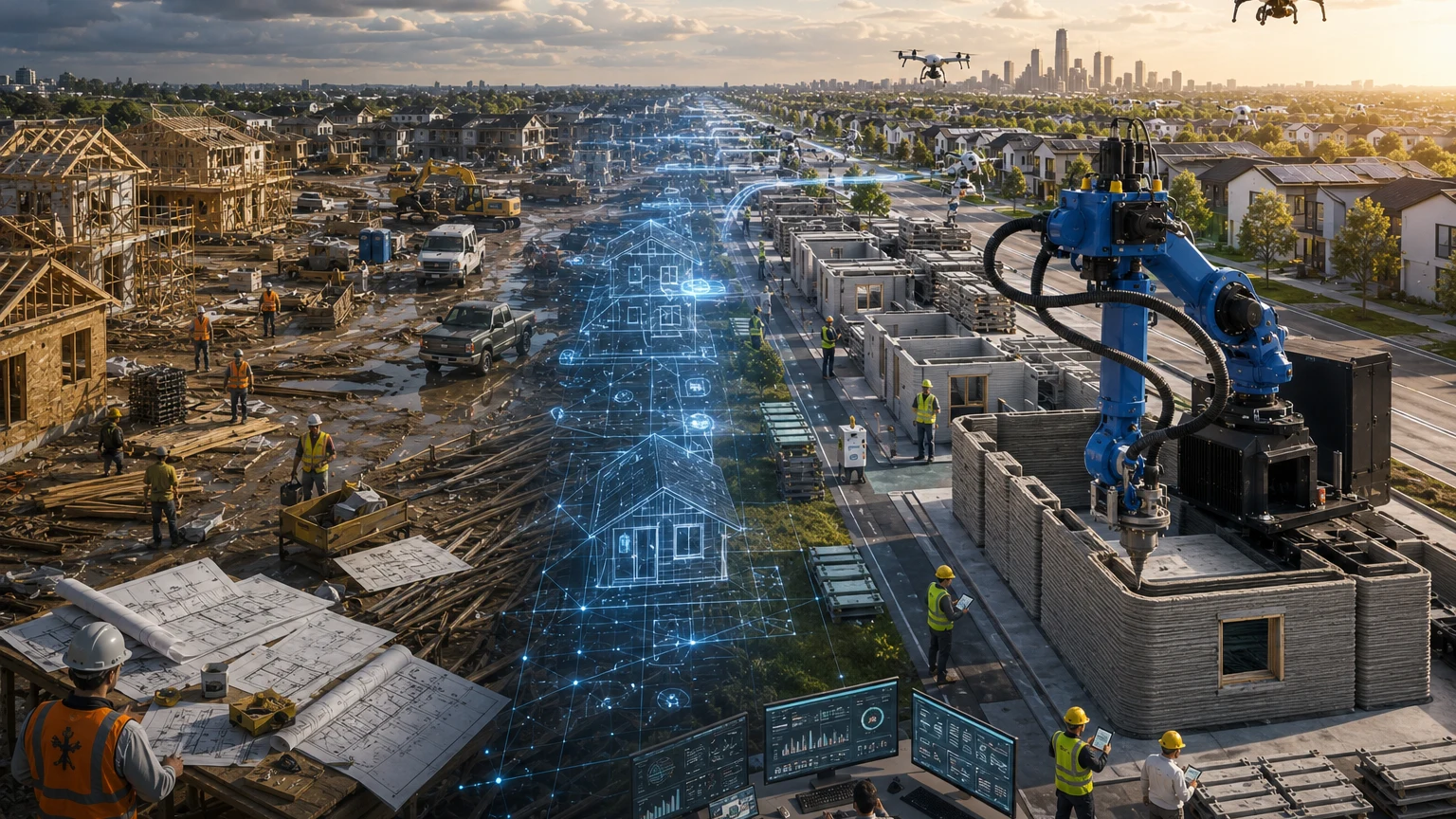
The Shift from Projects to Systems Is Already Underway
By C-Suite Executive
Over the past several weeks, a pattern has continued to emerge across housing policy, municipal initiatives, and market activity. What we are seeing is that what currently confronts the U.S. housing market is not a question of concept or intent, but of execution.
As established in Part 1 of this series, the conversation has already moved beyond policy momentum and into the harder question of scalable delivery. From “County of Santa Barbara Debuts Pre-Approved ADU Plans for Area Homeowners” to Boise’s introduction of free ADU designs, to New York City’s exploration of standardized templates in “Designs for New York’s A.D.U.s Are Here. These Are Our Favorites,” one theme is becoming increasingly clear:
The future of housing delivery will be defined by systems—not projects.
The Industry Is Quietly Rewriting Its Playbook
Historically, construction has been treated as a project-based industry. Each build is unique, each site introduces new variables, and each contractor operates with different methods. Timelines are often subject to disruption, making consistency difficult to achieve. That model is now under pressure.
Municipal initiatives such as Santa Barbara’s pre-approved ADU plans and Boise’s cost-reducing design libraries are not simply administrative improvements. They are early signs of a deeper shift: housing is beginning to move from bespoke execution toward standardized delivery. Even structured programs like the “2026 ADU Lottery Application Cycle Open April 1 – May 30 for San Juan County” reflect a system attempting to manage demand within constrained execution capacity.
The Real Problem Is Variability
In our prior analysis of where the real bottleneck now exists, we argued that access is no longer the limiting factor. Delivery is.
Across the combined article set, the same friction points appear repeatedly. Permitting timelines vary widely, construction costs fluctuate unpredictably, labor availability is inconsistent, and project timelines are rarely linear. Outcomes vary from builder to builder.
This variability is not incidental; it is embedded in how the system currently operates. As a result, housing struggles to scale efficiently, even when demand is clear and policy is supportive. If variability is the constraint, then acceleration alone will not solve it.
What the market requires is greater predictability in delivery, which demands a different way of thinking about how housing is produced. In other words, housing must be approached as a coordinated production system, rather than a sequence of isolated projects.
Where Al UltraProd Enters the Equation
As it relates to this aspect of our business—our holdings and operations—our focus has not been on incremental improvements to traditional construction, but rather on rethinking the underlying model.
Al UltraProd represents that shift.
Al UltraProd is often initially described in terms of its most visible component: Al-driven robotic construction using multi-axis systems capable of 3D-printing structural components on-site. But that description, while accurate, is incomplete.
Al UltraProd is not simply a piece of equipment. It is a systemized construction platform, built around four core pillars:
*Digital-to-physical translation
*Robotic precision execution
*Advanced material science
*Patent-protected process control
In practice, architectural and engineering designs are converted into Al-assisted, machine-executable instructions, reducing interpretation variability at the point of construction. Multi-degree-of-freedom robotic arms perform continuous-layer construction, supporting consistent structural output. The system utilizes proprietary ultra-high-performance concrete (UHPC) composites engineered for strength, efficiency, and durability. A portfolio of patents governs the interaction between software, robotics, and material deployment, supporting repeatability and defensibility of the system.
Speed Is Not the Advantage. Predictability Is.
As we previously argued in When Policy Unlocks Demand, Execution Determines the Winners, the next phase of housing will reward those who can convert intent into finished, compliant structures. To that end, there is a common misconception that the value of 3D-printed construction lies primarily in speed. While speed is relevant, it is not what ultimately defines the advantage.
What matters more is predictability—the ability to deliver consistent outcomes across environments.
The objective is not simply to build faster. It is to build with control, repeatability, reliability, and full compliance.
Santa Barbara’s pre-approved plans reduce design uncertainty, Boise’s free plans reduce cost variability, Kingston’s ADU Expo reduces informational gaps, and Jefferson County’s adoption of automated, platform-driven, plan review reduces administrative friction. Al UltraProd aligns with these trends by addressing variability at the point of execution.
Why This Matters for ADUs and Beyond
ADUs require adaptability, repeatability, precision, and efficiency at a smaller scale. This makes them a natural fit for systemized construction. However, the relevance doesn’t stop with ADUs. The same execution constraints exist across starter homes, workforce housing, infill development, and disaster recovery housing.
Wherever construction is fragmented, systemization creates advantage.
This would imply that the future of housing will be defined by execution systems, consistency, and scalability.
Recent Market Signals
In the weeks following the publication of Part 1 and the initial Part 2 analysis, recent developments across multiple markets continue to reinforce the same underlying shift from policy enablement to execution realities.
*New York City’s launch of an ADU-focused digital platform, integrating pre-approved designs, eligibility tools, and cost modeling, signals a move toward standardizing decision-making inputs and reducing upfront uncertainty in the development process.
*A San Diego ADU specialist firm, after completing more than 100 projects, identifies that the primary constraint is no longer approvals but information gaps across cost, permitting, and execution, indicating the bottleneck has shifted to delivery management.
*Done Right Builders & Remodeling’s expansion of end-to-end ADU design-build services in Santa Clara signals a move toward integrated delivery that reduces coordination risk across design, permitting, and construction.
Taken together, these signals reinforce a consistent conclusion: while policy continues to expand access, the defining challenge and opportunity have shifted toward execution, coordination, and predictability.
This is where Al UltraProd comes in.
Al UltraProd is not a concept. It is real. It is intelligent. And it is operational, already generating seven-figure revenues.
Closing Perspective
Housing will not scale through isolated projects. It will scale through coordinated systems of delivery that standardize inputs, control execution, and consistently produce compliant outcomes at repeatable cost and on reliable timelines. We believe Al UltraProd is well-positioned to be a strong national contender in enabling this shift.
For inquiries, collaboration, or strategic interest, contact: ir@securetechinnovations.com