
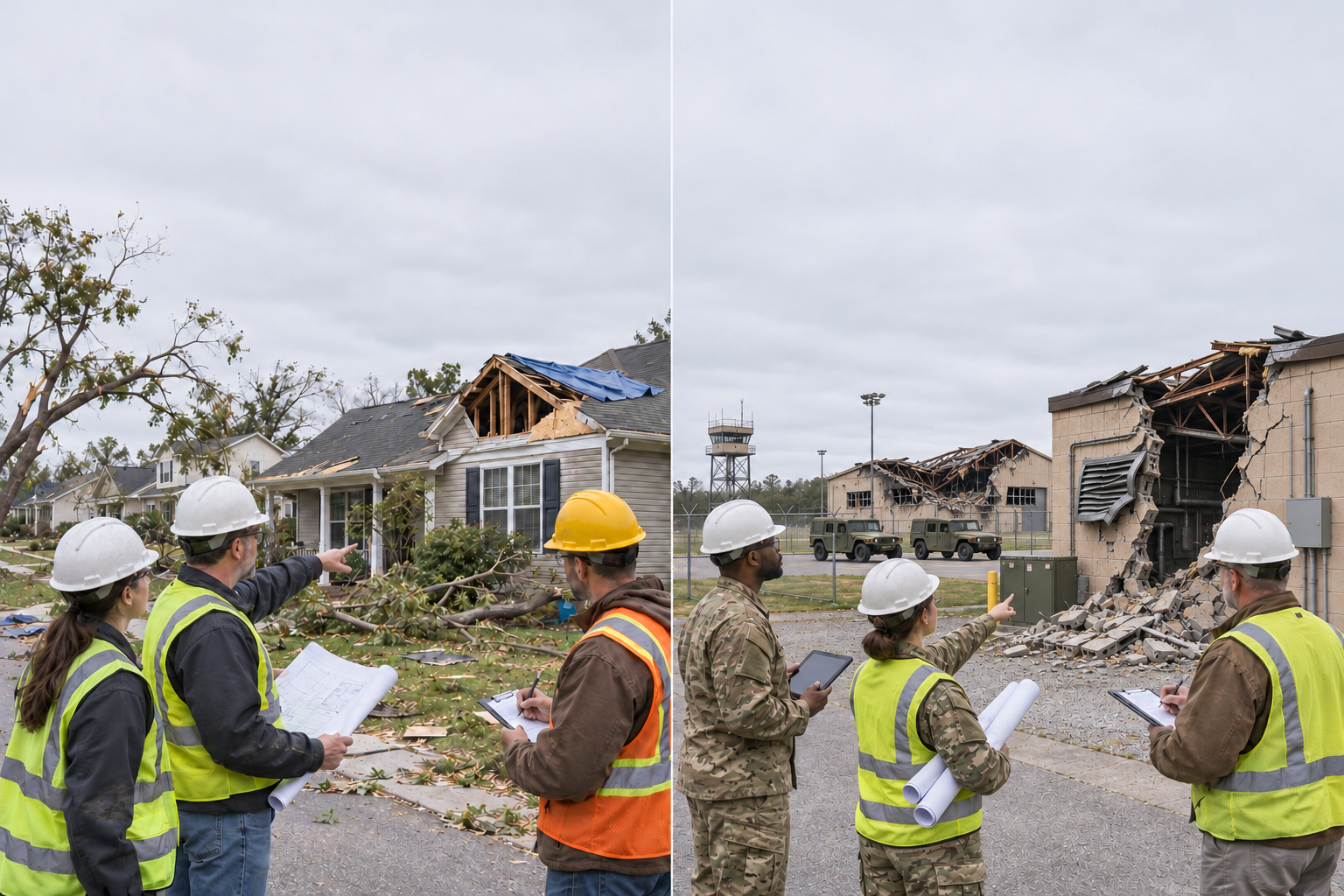
How mobile 3D concrete printing could help military planners and communities rebuild faster and design for future hazards
We recently came across a Navy Times article by Michael Peck that piqued our interest. After air strikes damaged U.S. base infrastructure in the Middle East, the Air Force outlined research into whether crews could use a mobile concrete 3D printer to quickly build protective structures at sites with limited resources. The effort looks at how crews would operate the equipment, whether they could use local materials, and how 3D-printed designs might protect occupants from blast and fragments.
Peck’s reporting caught our attention because communities face a similar challenge after hurricanes and other disasters, a subject we’ve discussed before. Roads may be damaged and crews and materials scarce. The replacement building still has to withstand the hazards that made rebuilding necessary.
In either setting, two questions matter. How soon can a crew deliver a structure ready to use? And how will it hold up to the hazards it was designed for, whether severe wind or blast?
The clock starts before the printer does
When a hurricane or an attack damages housing or critical facilities, the need to rebuild is immediate. The clock starts then, well before crews, equipment, and materials reach the site. It keeps running until the building is ready to use. After Hurricane Michael, the Air Force used 3D concrete printing in the Tyndall Air Force Base rebuild. The Air Force reported that the printed facility was designed to meet or exceed Miami-Dade’s high-velocity hurricane zone standards. Its walls were printed, while the roof, windows, and utilities used conventional construction.
At any site, crews still have to move equipment into position, prepare the ground, and set up power, water, mixing, and pumping. Printing can shorten the wall phase. Roofs, connections, utilities, and inspections still affect when the building can go into service. That’s the date that matters to a town waiting to reopen its public works facility. How quickly crews can deploy the printer affects how much time they can save overall.
Bring the printer to the work
Printing on site can reduce the need to haul large prefabricated components over damaged roads or rely on cranes where access is limited.
A gantry can print directly on a prepared site with room to assemble its frame. Where that setup is impractical, a crew might print components elsewhere and transport them in. Either approach adds a step that can matter when time is tight.
A crawler-mounted printer, however, eliminates the need to transport, stage and assemble a gantry frame at the jobsite. That removes a setup step and the labor it requires, which can matter when space is tight or crews need to start printing quickly.
SecureTech’s subsidiary, AI UltraProd (AiUP), offers the RC1-3100, a crawler-mounted concrete 3D printer. Its platform brings together AI-assisted design, robotic 3D concrete printing and proprietary ultra-high-performance concrete formulations.
The concrete has a schedule of its own
Freshly printed concrete must hold its shape under the next layer while still bonding to it. It also needs to gain enough strength for the crew to move to the next stage. Those milestones can come at different times as field conditions change. A mix that reaches the required early strength sooner may shorten the schedule.
The finished structure faces a different test. Compressive strength matters, and resistance to severe wind also depends on how the walls, roof, openings, reinforcement and connections work together. Blast and fragmentation create different demands. The Air Force plans to test how printed materials and protective shapes respond together. Digital design and robotic 3D printing can produce curves that are difficult and costly to form by hand. Engineering and testing determine which shapes suit the hazard.
What this could mean for rebuilding
In Rebuilding Begins Before Disaster Strikes, we looked at what communities can do in advance, from choosing sites to understanding what building officials will need. The Air Force’s question gives that planning a practical test. If a road reopens tomorrow, what can crews bring in, and what can they build with the materials on hand?
Some jobs will favor factory-made components. Others may benefit from printing on site or combining printed walls with a prefabricated roof. For SecureTech, that flexibility is where AiUP’s platform has value.
With AiUP’s platform, project teams can weigh the design, the robot’s mobility and the concrete together against two questions that matter to the people waiting on the building. How soon can crews put it into service? Will it hold up under the conditions it was designed for?