The Missing Layer Between Faster Construction and Broader Adoption
As housing policy continues to evolve and Accessory Dwelling Unit (ADU) initiatives expand across the United States, the housing market is confronting an important reality: Acceleration is not the same as adoption.
In Part 1 of this series, we explored how the housing market has increasingly shifted beyond policy momentum and into the more difficult question of scalable implementation. From “County of Santa Barbara Debuts Pre-Approved ADU Plans for Area Homeowners” to Idaho’s legislative push in “Bills Aim to Expand Starter Homes, ADUs,” the market is clearly moving toward enabling faster housing delivery.
Yet speed alone does not answer the questions that ultimately determine whether housing is accepted, financed, insured, and scaled.
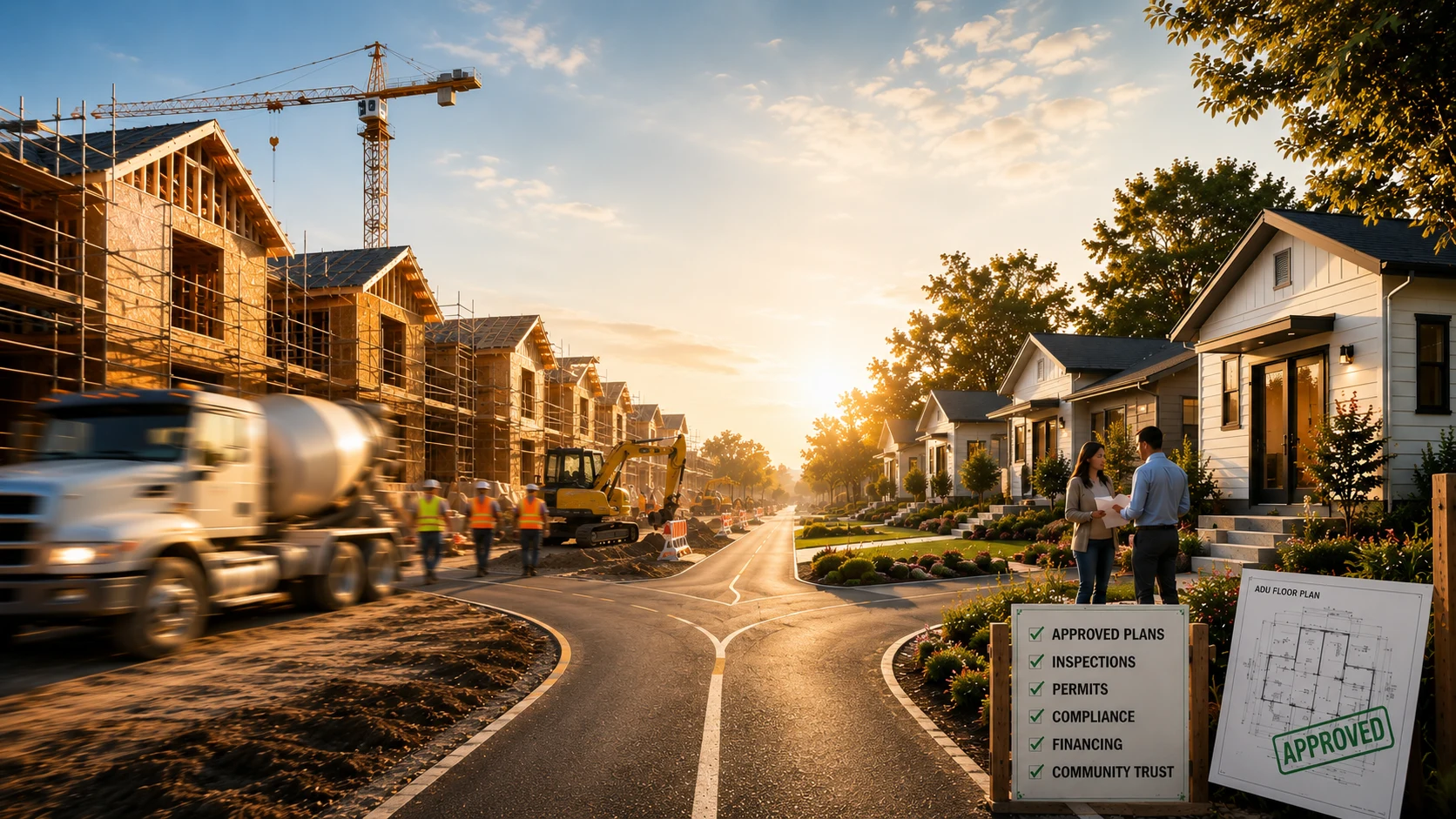
Put differently: Housing is not simply built. It is trusted.
The Missing Layer in the Speed Conversation
Much of the current discourse around construction innovation focuses on speed. Faster approvals, faster builds, and compressed project timelines are frequently presented as the primary solution to housing shortages. And rightly so. Speed addresses important supply constraints. But speed alone does not answer the questions that ultimately determine whether housing is accepted, financed, insured, and scaled.
- · Will it pass inspection consistently across jurisdictions?
- · Will it endure over decades under varied environmental conditions?
- · Will lenders finance it confidently?
- · Will municipalities approve it repeatedly without introducing new uncertainty into the process?
As discussed previously in our analysis of why the future of housing will increasingly be defined by systems, not projects, we believe the market’s next phase will depend less on isolated bursts of speed and more on predictability, consistency, and operational trust.
Despite growing enthusiasm for ADUs, questions surrounding long-term structural integrity, infrastructure compatibility, environmental resilience, and regulatory compliance continue to influence how new housing solutions are evaluated. For example, initiatives like Santa Barbara’s pre-approved plans (available for properties in unincorporated county areas) are not simply about efficiency. They are about ensuring that what gets built meets a known standard.
Similarly, legislative efforts highlighted in “Bills Aim to Expand Starter Homes, ADUs” are designed not only to increase supply, but to ensure that expansion does not compromise quality or safety.
The housing market does not reward speed at the expense of reliability.
Any new construction methodology, particularly one involving automation, robotics, or 3D printing, enters the market with an additional burden. It must prove not only that it works, but that it can be trusted to work repeatedly, under scrutiny, and over time.
That trust is built through demonstrated building-code compliance across jurisdictions, structural integrity under varied environmental conditions, insurance acceptability, financing eligibility, and long-term maintenance performance.
Without this layer, innovation remains experimental. With it, however, innovation becomes adoptable.
These are not speed questions. They are trust questions.
Engineering Trust Into the Construction Process
At SecureTech Innovations, we view AI UltraProd through a fundamental principle: Execution without trust does not scale.
This is why we believe AI UltraProd represents more than a faster way to build. Rather, it represents a controlled, compliant, and durable construction system.
Unlike traditional construction, where material consistency can vary based on handling, environmental conditions, and labor practices, AI UltraProd utilizes engineered concrete mixtures designed to achieve consistent flow characteristics, predictable curing behavior, high compressive strength, and reduced variability across builds. These ultra-high-performance concrete (UHPC) composites are engineered with the goal of meeting or exceeding structural requirements while maintaining precision during robotic application.
As we discussed in our earlier analysis of how AI-driven robotic construction is reshaping the future housing cycle, materials science and process control are emerging as important differentiators in scalable housing delivery systems. AI-driven robotic arms execute construction with high-precision dimensional control, continuous-layer deposition, and significantly reduced deviation from digital models compared to traditional labor-dependent methods. This reduces one of the most common sources of construction risk: human variability at the point of execution.
Every build is derived from a digital model translated into machine instructions, creating traceable construction processes, repeatable structural outputs, and more consistent compliance alignment. In effect, the system shifts construction from interpretive execution to programmatic delivery.
AI UltraProd’s patent portfolio governs the interaction between software orchestration, robotic movement, and material extrusion. This helps ensure that the system is not only differentiated, but also defensible and standardized, which becomes increasingly important when scaling beyond ADUs and across multiple markets and jurisdictions.
Why Trust Matters from ADUs to the Broader Housing Market
ADUs represent one of the most compliance-sensitive segments of the housing market.
Because they are often built in close proximity to primary residences, subject to local zoning nuances, financed through homeowner capital or lending, and scrutinized by municipal inspectors, they require a level of trust that exceeds many other housing categories. This is why initiatives like Santa Barbara’s pre-approved plans, New York’s standardized ADU designs, and local ADU expos and educational programs are all designed to reduce uncertainty, not simply accelerate activity.
The emphasis AI UltraProd places on consistency, compliance, and repeatability aligns directly with this need. The broader implications extend well beyond ADUs.
As the housing market evolves, a new competitive dynamic is emerging. It will not be enough to build faster. It will be necessary to build predictably, compliantly, durably, and repeatedly. Trust is becoming an operational metric. As we previously argued in When Policy Unlocks Demand, Execution Determines the Winners, the next phase of the market will increasingly reward operators capable of converting demand into repeatable, compliant delivery. Those who can embed trust into their construction systems through materials, processes, compliance, and repeatability will gain a structural advantage.
Whether in workforce housing, infill development, modular expansion, disaster recovery, or other emerging housing segments, the same requirement applies.
Speed may create opportunity. Trust enables scale.
Recent Market Signals
As this series has continued, recent ADU activity has reinforced the same pattern: speed matters, but scalable adoption still depends on trust, compliance, and repeatable execution.
- In Richmond, Virginia, one developer is reportedly pursuing 100 backyard cottages and says individual units can be built in 60 to 70 days, yet the city’s broader ADU data shows a meaningful gap between permits issued and units fully completed. That distinction reinforces the difference between construction velocity and fully adopted housing delivery.
- In Gulfport, Florida, officials proposed ADU rules on first reading while preserving owner-occupancy requirements, banning short-term rentals, excluding certain flood-hazard areas, and incorporating impact modeling tied to parking and neighborhood capacity. Though not yet finalized, the signal is clear: even where ADUs are encouraged, municipalities are carefully building trust through guardrails before enactment.
- In Bend, Oregon, pre-approved ADU plans are being used to reduce design costs, shorten permitting timelines, and give homeowners code-vetted templates, reinforcing the market’s movement toward standardized, compliance-oriented housing delivery.
Taken together, these signals point to a clear reality: the next phase of ADU adoption will not be defined by speed alone, but by systems capable of consistently delivering compliant, repeatable, and broadly accepted housing outcomes.
Taken together, these signals point to a clear reality: the next phase of ADU adoption will not be defined by speed alone, but by systems capable of consistently delivering compliant, repeatable, and broadly accepted housing outcomes.
Closing Perspective
Housing will not scale through speed alone. It will scale through construction systems that consistently deliver compliant, durable, and repeatable outcomes that homeowners, municipalities, lenders, and regulators can trust. As the housing market continues to evolve, we believe trust will become an increasingly important differentiator among housing delivery platforms. Those capable of embedding consistency, compliance, and repeatability into their construction processes will be best positioned to convert opportunity into scalable adoption.
For this reason, we believe AI UltraProd is well-positioned to be a strong national contender in enabling this shift across the housing market.